Healthcare software development for private clinics
Healthcare software development for a private clinic rarely starts from nothing. Semble, Cliniko or WriteUpp already runs the diary, notes and invoices. We build the healthcare automation around them: enquiries, fee letters, insurer billing, results and records requests, with AI drafting and a named person deciding.
In England a clinic carrying on a regulated activity registers with the CQC and keeps contemporaneous records; in Scotland, Healthcare Improvement Scotland regulates independent clinics. The CMA's 2014 order sets what consultants tell patients about fees, and MHRA guidance separates admin software from medical devices.
Where the time goes
Enquiries and fee information
Each enquiry needs a reply, a funding route and a booking. Where a consultant sees private patients, the CMA order requires written fee information when the appointment is confirmed, including the estimated cost, any financial interests, the insurers that recognise the consultant and PHIN's web address.
Insurer billing
Insured patients' invoices can go electronically through Healthcode's Clearing Service, which checks the codes and formats needed for payment. Healthcode cites rejections from incorrect codes, incomplete patient details and missing pre-authorisation information. Remittances are matched and shortfalls billed to patients.
Notes, letters and results
Regulation 17 asks for an accurate, complete and contemporaneous record of each patient's care and the decisions taken. CQC's guidance adds that test results and correspondence are filed without undue delay, and that consent records show when consent changed and why.
Records requests
A subject access request is answered within one month, extendable by two months if complex, and is generally free. Unless the controller is a health professional, health information the patient has not seen goes out only on the appropriate health professional's opinion on serious harm; efforts are documented and, without a timely opinion, it is withheld.
The systems you already run
Semble
Practice system and health record for private clinics. Its GraphQL API takes a scoped token and sends signed webhooks for bookings, invoices, lab results and letters. It sends PMI invoices to Healthcode, and Heidi's AI scribe can be used within it.
Cliniko
Practice software for clinics and allied health. Its REST API covers patients, appointments, invoices and treatment notes, with a per-user API key carrying that user's permissions. The documentation describes no webhooks, so we would check for changes on a schedule.
WriteUpp
Practice software for physiotherapists, psychologists and therapists, with online booking, a Healthcode integration and an AI Scribe whose notes come ready for the clinician to review. Its Open API reads appointments, patients and invoices, and can add patient notes once WriteUpp enables that.
Healthcode
Its Clearing Service validates invoices for many of the largest insurers, and Electronic Remittances match payments to bills and report shortfalls. Its APIs let developers integrate with the Clearing Service, enquire on membership and download remittances.
What we would build
One queue for new patients
A healthcare CRM for enquiries: web form and inbox messages in one queue, sorted by service and funding route, replies drafted for reception, bookings made through your practice system's API, and fee information sent and logged.
Fee estimates on the order's clock
Drafts each estimate from the consultant's fee schedule after the final pre-treatment consultation: the reason for further tests or treatment, the cumulative consultant cost and what is excluded. It tracks the two working days and records the signed confirmation.
Billing checks before Healthcode
Checks each insured invoice against its booking before it goes: pre-authorisation, codes and patient details. After payment it matches remittances to invoices and drafts shortfall invoices for your billing lead to approve, across every site in a group.
Results and records requests
Matches lab results and letters arriving by email to the right patient, files them for the clinician and flags any it cannot match. A request log counts the one-month deadline, stops the clock for clarification and asks the responsible clinician for a serious harm opinion.
Where AI helps
AI should not triage, score or suggest a diagnosis on its own: MHRA guidance ties those functions to medical devices, and rates a scribe suggesting diagnoses without showing its reasoning as high functionality. NHS England's guidance has users review and approve scribe output before it is acted on.
- Sorting enquiries by service and funding route and drafting replies, with reception reading and sending each.
- Drafting clinic and referral letters from the clinician's notes, with the clinician editing and signing each one.
How we would start
We would start with one service and one month of new patients, from first enquiry to first appointment: where enquiries arrive, who replies, how funding is checked and when fee information goes out. The first working version would connect to your practice system's API, gather web form and inbox enquiries into one queue, draft replies for reception and log each fee letter.
That first stage, the design and a written scope, typically takes one to three weeks. Like every stage, its price is fixed and agreed before it starts, and you can stop after it. How a project runs
Rules we build around
The software keeps the records these ask for. The duties stay with you.
Health and Social Care Act 2008 (Regulated Activities) Regulations 2014, regulation 17
In England, carrying on a regulated activity, such as treatment by doctors or nurses or diagnostic imaging, without CQC registration is an offence under the Health and Social Care Act 2008. Regulation 17 requires secure, contemporaneous records of each patient's care and decisions.
Private Healthcare Market Investigation Order 2014, article 22
Consultants give fee information in writing when an outpatient appointment is confirmed and, except in an emergency, an estimate before further tests or treatment within two working days of the final pre-treatment consultation, or before surgery if sooner. Facilities must require this of consultants practising there and ask patients having a procedure to sign that they received it.
UK GDPR Article 9
Health data is special category data: a clinic needs an Article 9 condition, such as health or social care, alongside a lawful basis, and a DPIA for processing likely to be high risk. NHS England's scribe guidance also asks for DCB0160 clinical safety documentation.
MHRA guidance on software as a medical device
Booking software with only an administrative function is unlikely to be a medical device, and a record that replaces the paper file is not one. Decision support that applies automated reasoning usually is, and MHRA's 2025 mental health guidance counts triaging, screening and scoring as clinical tasks.
Software we built and still run
-
ADHD Private
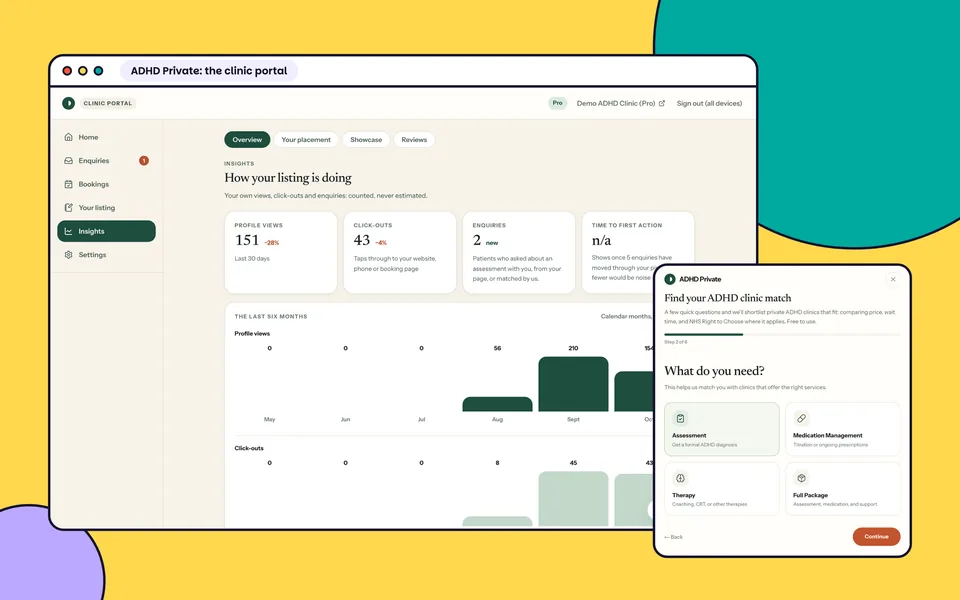
We built and run ADHD Private, a UK directory of private ADHD clinics. Each clinic fact is checked against a quote and a source. A portal lets clinics answer enquiries and update listings, logging every edit by field and author; a patient's message stays there, never in email.
Questions
We already use Semble. Do we need anything built?
Often not. Semble Connect links over 1,200 tools without custom integrations, and Heidi's scribe works within Semble: try those first. We build what no single product covers, such as fee estimates on the CMA order's clock or billing checks across sites.
Can AI triage our referrals or score questionnaires?
It can sort referrals by service and summarise them for a clinician. Scoring answers, ranking urgency or listing likely conditions are what MHRA guidance ties to medical devices, so clinical judgement stays with your clinicians.
Do the rules differ in Scotland?
Yes. Healthcare Improvement Scotland regulates independent clinics where doctors, dentists, nurses, midwives, dental care professionals, pharmacists or pharmacy technicians provide services, except, for example, clinics offering only talking therapies. The CMA order covers the whole UK; NHS England's scribe guidance covers England only.
We take NHS Right to Choose referrals. What changes?
In England, most patients referred for consultant-led treatment or to a mental health professional can choose their first outpatient provider from those with an NHS contract for the service. Any organisation with access to NHS patient data and systems must use the Data Security and Protection Toolkit. We label each patient's funding route from the first enquiry.
Can you build a patient app?
Yes: healthcare app development for booking, forms, payments and messages is web app work we do. A symptom checker that lists likely conditions may be a medical device under MHRA guidance, so we settle that before design.
Sources
Every rule, date and figure on this page comes from the sources below, checked on 31 October 2026. Rules change: check anything that matters with the source or your adviser.
The 30 sources
- Semble: Electronic health record (Heidi AI scribe integration)
- Cliniko: Practice management software
- WriteUpp: Practice management software
- WriteUpp: AI Medical Scribe
- legislation.gov.uk: Health and Social Care Act 2008, section 10
- CQC: Regulation 17: Good governance
- Healthcare Improvement Scotland: Regulation of independent healthcare
- CMA: Private Healthcare Market Investigation Order 2014 (as amended, 28 April 2017)
- MHRA: Medical device stand-alone software including apps (v1.10g)
- PHIN: PHIN's mandate and governance
- Healthcode: Claims management (Clearing Service, Electronic Remittances)
- ICO: Right of access: what should we consider when responding to a request?
- ICO: Right of access: health information
- Semble: Integrations and API
- Semble API: Authentication
- Semble API: Webhooks guide
- Cliniko: API documentation
- WriteUpp: Private practice software (Healthcode integration, online booking)
- WriteUpp: What is the WriteUpp Open API?
- Healthcode: Integration for software developers
- MHRA: Digital mental health technology: qualification and classification (PDF)
- NHS England: Guidance on the use of AI-enabled ambient scribing products in health and care settings (v3, 29 July 2026)
- legislation.gov.uk: Health and Social Care Act 2008 (Regulated Activities) Regulations 2014, Schedule 1
- ICO: Special category data
- MHRA (GOV.UK): Digital mental health technology: qualification and classification (first published 3 February 2025)
- Semble: Semble Connect (healthcare automation)
- legislation.gov.uk: National Health Service (Scotland) Act 1978, section 10F
- Healthcare Improvement Scotland: Information for service providers: Independent clinics
- DHSC: The NHS Choice Framework (updated 23 October 2024)
- NHS England: Data Security and Protection Toolkit
Tell us what you want to build
A few lines is enough to start. We reply within one working day.
Start a project